Showing posts with label Networked Mashup. Show all posts

Thursday, December 07, 2006

Tele-Trigger


Jonathan and myself worked on a project for the last three days using C.O.D.A [Collababorative Online Digital Arts] system to create a piece for a tutorial. The piece is two TV's facing each other with a web cam on each. Each TV has displays the feed form it's webcam. As you aproach each TV an infra-red sensor makes the screen fade to the feed form the web cam behind you. Simple but effective we think. Keir

The Planetarium


Myself, Jonathan Green and Steven Davis went to visit the new digital Planetarium at Millennium Point, Birmingham. It's a giant aluminum dome that has a set of six overlapping projectors around the circumference. We watched a demonstration of the system. It consisted of a tour of the stars starting from a British night sky then flew through to a view from the moon. This was done using a wireless PDA and joystick. When we looked at the possibilities for out work we all came up with quite different ideas and concepts. I won't go into these yet but what was very useful for us was the very helpful Mario Di Maggio who runs the planetarium. He showed us the workings of the place. It all runs from a standard xp server running software that we can hack into with C.O.D.A. system myself and Jonathan are working on at the moment. this means we could control aspects of the projection with sensors, phones, dancers, mikes and anything else we can think of. The real challenge of the whole project will be the 3000*3000 resolution needed. This then has to be distorted to allow for the shape of the dome. Anyway further details to come...

Tuesday, November 21, 2006

Mat Gough - Hyperchoreography

I've been looking at Mat Gough's Blog again to try to see how he can fit into both my dissertation and the Network Mashup work we've been exploring.

The following quote from his blog fits with the work of Cunningham and Cage that I've been looking at in the use of chance within a rigid structure. Also the multi-directional links he describes is what we're trying to create with the tagged data from our system.

"in a networked environment where all links are revealed and 'new' links can added by users, multi directional - two way connection enhance the perception of intertexts. no longer must the author use chance procedures to disrupt their unconscious constructions of meaning, the provision of a mechanism to explore, expand and visualise the intertexts of their authored text performs the same function."

- Mat Gough - networked choreography - ii

Mat Gough says previously to the above quote:

if the initial conditions (the movement corpus) of a dance work are small and ring-fenced (the choreographer produces, selects and controls the material) then our bias for particular semiotic readings results in a low level of indeterminacy. the only way to achieve 'maximum' indeterminacy is for the choreographer to exert minimal control over the movement corpus.

'minimal control' of the corpus need not mean 'found' choreography in the tradition of 4'33", if we define choreography as 'making structures in which movement may occur' then the choreographer can still retain some ownership of contextual meaning. presented in an appropriate structure, divergent content forms the dissonant harmony of authored indeterminacy

- Mat Gough -networked choreography - ii

I think the next quote fits with the manner in which Cage and Cuningham work in Variations V. The chance element of the dancers position to the antennae and the creation of the score using dice rolls within Variations V is the minimum control within the corpus of the work. This creates an indeterminacy within the work. However they still maintain a 'ring-fenced' approach to the work in the rigidity of the over riding structure of the piece by Cage and Cunnignham. This lowers the level of the indeterminacy by reducing the divergence of the forms within the piece. The framework is static with the chance creating the indeterminacy within the structure creating a 'fabricated' hyperchoreography as the indeterminacy of the mixing forms is limited within this static structure.

Rhizome - Deleuze & Guarttari

I've been reading a section of Deleuze & Guarttari's essay 'A Thousand Plateaus: Capitalism and Schizophrenia. I was advised by David Cheeseman my MA tutor to look at the theory of the Rhizome as it applies to Jonathan and my work on creating adaptive creative frameworks. I don't want to attach a response to the work yet as I'm still trying to take in the language of the essay which is pretty hard going. Above however I will take out quotes that interest me and I think have a relevance to the work we're creating.

The Networked Mash-Up: Gridded Resources in Real-Time

The following is Jonathan's write up of the notes we made for our Network Mashup presentation they are originally on Jonathan Green's Blog. We worked together through this project and we will be both expanding on notes written up here.

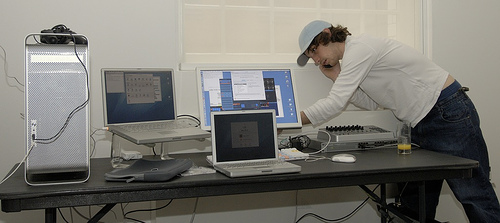
An overview of a demonstration by a VJ (Keir Williams), electronic musician (Jonathan Green) and a dancer, of a computer network designed especially for the performing arts.

Identification of Possibilities of E-Science

Gridded technologies allow for collaborative performances. The traditional separation and resulting lack of synchronisation between disciplines during performance is abandoned in favor of a modular system which promotes learning, exploration and experimentation which often leads to happy accidents.

The gridded distribution of artists and technical know-how does not, as may be expected, decrease the strength of relationship between disciplines, but rather makes possible a more integrated performance through interdisciplinary communication. The notion of content fusion is a result of the inclusive methodology employed.

Since usability has been a priority in the conception of the system, performers (dancers, VJs and electronic musicians in this case) are liberated from the burden of poor software interfaces and are instead free to concentrate on interpersonal communications and the reactions of other performers.

We wanted to use novel and user-friendly hardware interfaces to the complex computer software we needed to use. We chose gamepads, fader boxes, microphones (audio analysis) and motion sensors. We took the idea of interfacing a little further and thanks to an iSight and motion capture software especially designed for the system, we were able to use a dancer literally as a bidirectional computer input device. The dancer provided real-time motion data and at the same time was free to react to the sense of space and the resultant projections. This interactive performance ‘loop’ became evident on several levels.
Conclusion of Possibilities

Through the demonstration we had proved that our concept of the networked mash-up had some promise. Our system allows for synchronisation between different performance disciplines. We even managed to prove the system not only in a local network, but also over the internet (see Remote-Controlled Max Patches post). Our system could be scaled up in terms of number of nodes, collaborators and geographical locations (see Future Possibilities below).

Practicalities of a Distributed Performance System

The system is based on a number of nodes. In our demonstration we had three computer nodes (network devices, in other words). It could be argued that the dancer herself is a node, since she feeds and reacts to other nodes. A node, therefore, does not have to be a computer or a traditional network device.

Some example of possible nodes:

* musical instrument (audio analysis, done at source, provides the control data)
* sensor networks (motion capture and environmental data)
* RSS feeds (the internet as a node)

Our gridded system is open to data generated externally. A real-world example of why this might be absolutely necessary: random numbers. Computers cannot generated entirely random numbers. During our demonstration, we accessed a website which publishes random numbers generated by the beta-decay of Krypton-85.


What is Distributed?

* computing power – we could not have done video analysis, audio synthesis and real-time video processing on a single computer
* data – any computer on the network could contribute data or pull down any data and then transform it in a specialised manner

In contrast, the following is not distributed:

* specialist performer skill of specific disciplines
* function – each node carries out its own specialist function

An important concept here is that each node does not need to know how other nodes function, only what data they produce, and even then, each data packet does not have a sender’s address.

At the moment all data exists in a relatively flat hierarchy (like MIDI). There is no means of filtering out unwanted data according to characteristics, type, source or any other meta data. This would certainly be a limitation if the system were expanded.

Data is broadcast in a sterile format that does not favor any particular discipline. It is up to a particular node to filter the data in a way which is appropriate to the function of that node.
Future Possibilities

As explained above, we are limited by the data protocol. At the moment, we are using MIDI which is non-descriptive. This not only makes it difficult to use, requiring a separate document giving a description of each stream of data, but also limits scalability. By tagging data with meta-data, we solve not only issues of scale but also usability. By using a more human-readable protocol (such as Open Sound Control) we can draw a parallel with existing, proven data filtering systems employed by Flickr, YouTube and del.icio.us.
Conclusion (Social Impact)

The notion of distribution, whether computing power, data, knowledge or responsibility is suggestive of the Open Source paradigm. Open Source projects often have a wide user-base and community of enthusiasts. Collaboration is taken for granted.

If scaled up, the Networked Mash-Up idea could bring together artists from diverse backgrounds and working practices in a non-location specific manner (although the location of nodes could be conceptually exploited).
Resources

* Network schematic screenshot
* E-Science Max Patches (used in demonstration)
* Photos from the E-Science workshops on Flickrr> * Remote-Controlled Max Patches – notes on expanding the system
*
Video of performance on YouTube

Monday, November 13, 2006


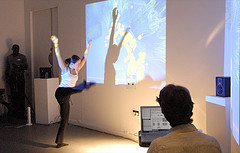
This is the video of the performance. As you can see we've got Susan dancing in front of a video camera. This is then analaysed and sent into the grid. In turn this is picked up by myself as a midi feed and video feed into my VJ package Modul8 . It was also available for the sound program on Jonathan's computer which interprited the midi data, creating a sound scape. We then layered a set of controls on this allow myself and Jonathan to control both the video and audio from any point on the grid. The controllers were a midi mixing desk and a usb control pad.


Well here is a image of the performance taken by the photographer Mike Priddy.

The Networked Mashup - Key Note Presentation

Well here's the start of it. The keynote presentation myself and Jonathon used after the demonstartion of the system. I'm just editing hte video and will include it and a flickr images of the performance.
As I haven't yet had a chacne to write up the notes for our project yet I've included a link to Robert Sharl's blog, Futurilla which has som einteresting comments about the day.

Sunday, November 12, 2006

VRU eScience Workshop

Well the workshop went ahead as planned and I think myself and Jonathan got the ideas behind the work across to the audience. Ill be adding a description of the project, our keynote presentation as well as youtube and flicker feeds tomorrow [Monday].

Wednesday, November 08, 2006

Our workshop for the eScience VRU workshop project is on Friday. So myself and Jonothon Green have been experiemtning with our setup. We introduced Susan, one of the contemporary dancers I've been working with into the space today. We practiced with her in the space and talked about her use as an input device into the creative grid we've created. This is interesting because we're intereseted in setting up this complecated system and then removing a level of control. So with sound we have reduced the control of the sound that she is creating by being in the space, by using a game pad. With the video control I'm effecting the VJ program from a remote computer using a set of audio faders and nobs.

Monday, November 06, 2006

My Live Feed Adventure


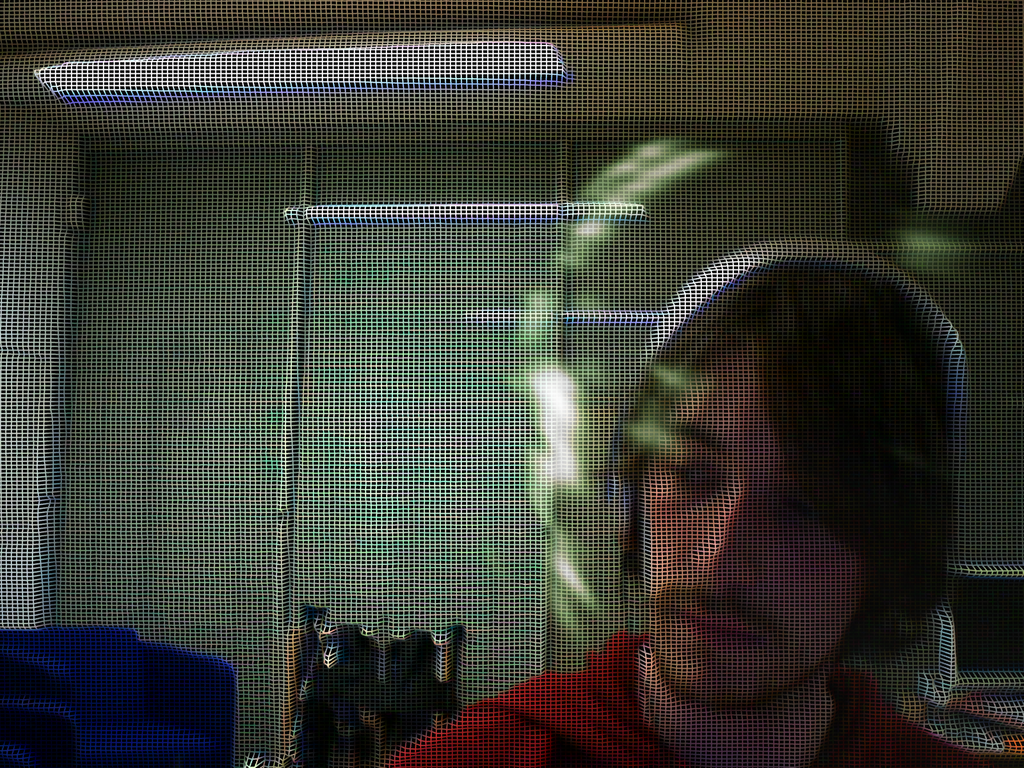
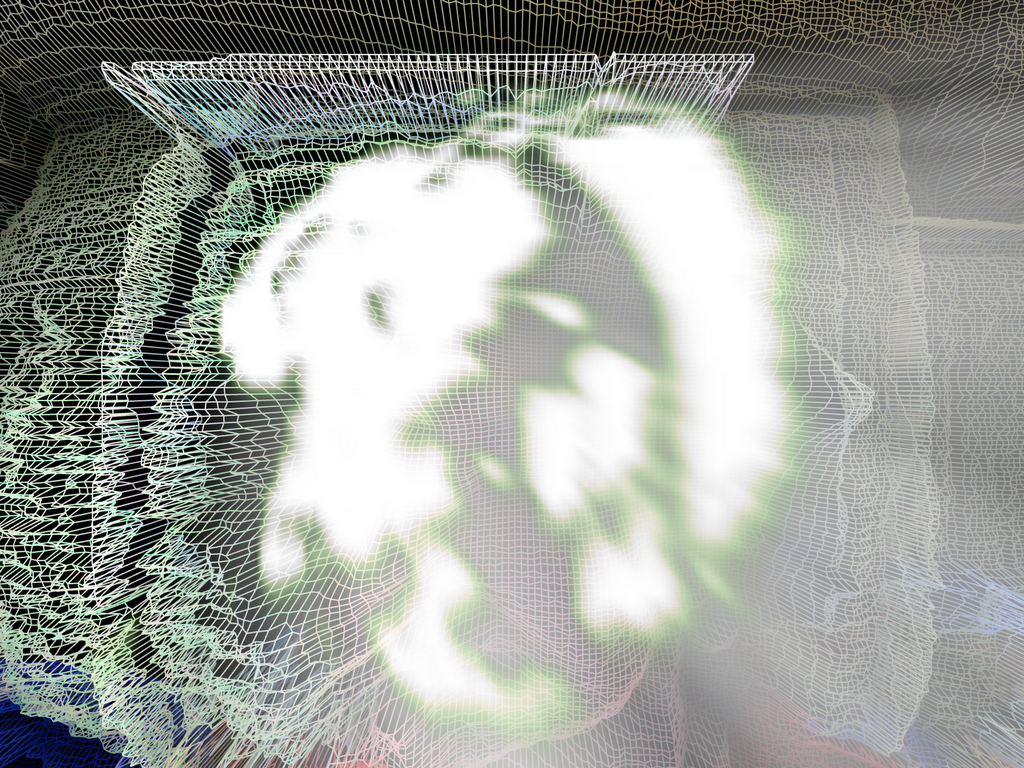
These images are stills form my a piece myself and Jonathon Green are creating for a workshop at the Ikon Gallery this Friday [10th Nov. 2006]

We've been using a mashup of Modul8 and Max_msp. Basically we have a video feed from one computer on the net running image analasys through Max_msp and then sent to the next computer as a udp stream. This is then picked up on the other computer in a Max patch and transformed into a midi stream. This is then used to control the Modul8 VJ program with live feeds from the video analysis form the other computer.