It's been half a year or so since I've been on this Blog but I know I've finished my MA I actually feel like using it more. I'm going to chuck on a load of photos and maybe some films which I might explain later. Maybe....
Saturday, September 29, 2007

Wednesday, March 07, 2007
Body and Line
I've been experimenting with projection and recording the result. I want to use some thing like this projected onto screen prints. I then want another set of forms projected over the top of this projection that visually reacts to the viewers position in the space
technorati tags:line, body, art, projection, forms, art, CODA, keir, williams, vru
Friday, February 16, 2007
Jam Jah rides again
We got sent this by Jerome from Baroque Dub who took it in Newzeland. Look out for the new Jam Jah Soundsystem Vol. 3 CD which will be featuring these amazing images. Nicely.

Thursday, February 15, 2007
Some Brain Pictures
Here are some photos from the installation Brain Dub. They where taken by the ever amazing Mike Priddy I love the texture created by the displaced grid and the pixles of the projection.


Belfast
Myself and Jonathan have had a joint paper excepted for the Two Thousand + SEVEN electronic arts festival at the Sonic Arts Research Centre, Queens University Belfast. This is part of the Sonorities Festival of Contemporary Music.
This is the paper we submited. We have half and hour and hopefull this will continiue on from the Network Mashup paper we gave at the Ikon in 2006.
Abstract
For performance artists, the development of stable, networked performance environments has relied heavily on the importation of models of the ‘social’ inter-personal communication type. Given that such communication responds to merely an aspect of the needs of artists, in practice this proves to be an imperfect and incomplete tool. In response to the challenge of producing a more rounded environment, the authors, through their work at the Visualisation Research Unit (VRU) at BIAD, have developed Collaborative Online Digital Arts (CODA) as a platform for drawing together networked resources from different disciplines.
The benefits, drawbacks, needs and future possibilities of existing networked performance will be discussed, as well as the omissions and shortcomings of CODA and other real time applications. However, the principle of creating a virtual performance environment has been abandoned for enhancing the traditional physical performance environment.
CODA was developed specifically to facilitate inter-disciplinary communication in multi-disciplinary performances. Central to CODA is the concept of the node. A node can be a computer with a specialist function, a sensor network, a human-computer interface device or even a person. All nodes broadcast media-in-specific data to a virtual data pool from which every node has access. This allows performers to interact with the environment without the necessity of having in-depth knowledge of how the data is being generated. For example, this allows the output from a video analysis node to be easily mapped onto a sound synthesis parameter on another node.
CODA could be thought of as a single ‘super instrument’ with which all performers can interact simultaneously. The technological infrastructure of the instrument is hidden, but the interface is not. Performers do not need to learn how it works, instead only what interactions it understands and what the results of those interactions may be. This methodology improves performer spontaneity considerably and lends itself particularly well to improvisation incorporating different disciplines where ad hoc exploration and experimentation are important.
This suggests that the network is itself the instrument, and leads to a further interesting phenomena. The data produced can be automatically archived and endlessly reformulated after real time presentation.
The paper will be presented with a short demonstration of CODA.
technorati tags:CODA, Network, Mashup, Keir, Jonathan, Williams
Present Tense
Myself and Jonathan have just finished our entry for the WRO 07 electronic arts festival in Poland this year. Below is the synopsis we've made and some images of the piece.
Present Tense: Synopsis

Present Tense installation by Jonathan Green and Keir Williams
Present Tense is an interactive sound and video installation exploring individualism in the immersive and almost anonymous information age.
This visitor-reactive multimedia installation presents its materials in real-time in the form of RSS feeds, audio from an analogue radio and live video feeds of the visitors as they enter the installation. Video generated from these materials is back-projected onto fabric, hung in a circular pattern from the ceiling. This creates a small multimedia ‘chamber’ in which a simple dial is situated on a plinth. Turning the dial allows visitors to scrub back in time (the live content is archived in real-time), viewing previous visitors and recalling text from RSS feeds whilst retuning the radio.

Keir Williams interacting with Present Tense
This deluge of information and the ability to navigate through time contributes to the claustrophobic and personal effect of the chamber, which in turn highlights the minute, yet all-powerful role of the individual in relation to the universal dimension and anonymity in the multiplicity of today’s media. The tension generated by the immediate and localised experience of the recent and global past within the present forms an integral part of installation.

Present Tense projection
Present Tense: Further Information
Additional information is available as PDF files for download
There are also more images are available on Flickr and there is a short movie on YouTube.

Close-up of the controller (jog wheel) for Present Tense

Layout schematic of Present Tense
Thursday, January 25, 2007
Brain Dub
Those wonderfull people at Filmcafe.co.uk have given me some space on there sever to allow me to put up non flash encoded youtube films. Hoorey! HD tastic. [Although this is just a little version of my new Brain installation.]
Monday, January 15, 2007
Wiiiiiiiiiiiiii
Today I bought a Wii remote to see what me and Jonathan Green could come up with. We managed to get it to work as a midi controller, change colour and control a set of moterised faders. So far I've only found audio hacks for the Wii. So hoorey!
Tuesday, December 26, 2006
Questions
What frameworks and technologies for inter-disciplinary performance facilitate collaborations between art forms?
Inter-disciplinarity draws insights from and integrates two or more disciplines. - Wikipedia
Foundations
This essay starts by considering what are the meanings that we give to 'inter-disciplinary' performances. It investigates how they facilitate open-ended collaboration among art forms. It concentrates specifically on the ways in which network technologies bring together dance, music and video. It draws on Latour's accounts of frames, which situate signs in terms of time, space and actants: ... [constructions which] are animate, inanimate or even abstract entities ...' (Williams, R. 1992, paraphrasing Latour 1988). Signs may involve description (to write down, creating a trace), inscription (to make a text), subscription (to support another frame, text, trace), conscription (to mobilise a frame, sign, text, trace in performance), transcription (to write across and thus to rework or transform a frame, text, trace in performance). Frames may take many forms. My concern is with the ways in which sets of performances, involving music, dance, art and video are framed by and frame one another.
My initial project is to consider examples of how inter-disciplinary performances have worked within and across these frames - and the signs, texts and traces which they situate. My second is to examine the contingent dialogues that may take place within and across the frames, in which the movement of each defines the movement of one or many others. The study will examine the possibilities and limits of specific technologies that have been used and which might be developed to create new kinds of performance.
In my own practice, with a focus on interactive video, I work with people from different disciplines, both 'artistic' and 'technical'. This led me to work with Jonathan Green to develop Collaborative On-line Distributive Art (CODA). This study will look at the opportunities this systems enables, the work I have created with it, and my own use of it. CODA can create networked environments where dance, music, art, video and data streams can interpolate over local or global networks.
Performances typically use a call and response frame to situate actants. Dancers, musicians, actors respond to one another and audiences whether these are improvised or set in time and space. The recording and play back of dance is not the same as live performance. Video, like film, is produced according to its own language and technologies. Live, non-linear and interactive editing and manipulation systems allow video to collaborate in live performances. The editior or 'VJ' can now edit/ perform live in reponse to dancers and musicians.
Network systems that allow interpolated data streams between video, music and dance create new possibilities. The performance space is constructed from multiple feeds of sound, image, movement and architecture. My own work concerns itself with presence within an architectural space. The human element is the live control and response to the constructed environments. It creates resonances, tensions and disruptions among all these elements. Networked systems allow us a fluidity among sets of frames. Does this create space for emergant forms of expression?
Examples
To explore the themes and constructs I have identified I need to set my own work against that of several differrent practitioners. The examples I have chosen identify different ways of combining artitic performances and network technologies.
An example of the inter-diciplinary work I will consider is the collaboration between John Cage, Merce Cuninngham and others, specifically in their 1960's work, Variations V. The dancers perform in a space constructed by movement which generates and triggers sound. These are then filtered and reconstructed by the audio artists. Mixed television images and film are projected on to screens around the space but are themselves unaffected by the performers other than their physical placement. Cunningham's recent productions use the Lifeforms software to choreograph virtual performers the movement of which is then transposed onto live dancers. The video instillation 'Ghostcatching' uses virtual dancers transposed from motion captured of human dancers. (Cunningham and Jones, 2004)
I will investigate Matt Gough's critical work on hyper choreography. My interest lies in his theories of the possibilities for audiences to create and alter perceptions of work by creating ' ... a networked environment where all links are revealed and 'new' links can added by users, multi directional - two way connection enhance the perception of intertexts. No longer must the author use chance procedures to disrupt their unconscious constructions of meaning, the provision of a mechanism to explore, expand and visualise the intertexts of their authored text performs the same function.' (Gough)
Michael Takeo Magruder by contrast uses algorithmic programming to take live feeds from the internet. 'Each article is deconstructed into its basic image and text components. This material is then algorithmically recombined into an aesthetic entity in which the informational content is still partially discernible.' (Magruder)
These issues emerge out of and provide instances of wider overlapping traditions of multidisciplinary performance. The final dissertation will be written and submitted as a blog. This allows readers to access hyperlinked references to the text, include video, sound and images embedded within the text. The ability to tag paragraphs enables the reader to reorder and filter the text they want to read. This approach will reflect both the subject matter and method of this essay.
References
Latour, Bruno, "A Relativistic Account of Einstein's Relativity', Social Studies of Science, 1988, Vol. 18, pp. 3-44.
Williams, Roy, "Discourse analysis of social documentaries on television" Ph. D. thesis, University of the Witwatersrand, 1992.
Magruder, Michael Takeo, http://www.takeo.net
Gough, Matt, http://binarybutoh.blogspot.com/
Cunningham, Merce and Bill T. Jones, "The Ghost in the Machine" A Journal of Performance and Art, Vol. 24, No. 1, pp. 94-104. 2004
Bibliography
Gould, Stephen Jay. Wonderful Life : the Burgess Shale and the Nature of History. MIT Press, March 13, 2006
Antin, David. Video: The Distinctive Features of the Medium. Touchstone/ Simon & Schuster, 1967.
Massumi, Brian. A User’s Guide to Capitalism and Schizophrenia : Deviations from Deleuze and Guattari. MIT Press, 1992.
Pressing, J. "Cybernetic issues in interactive performance systems" Journal of Comparative Music, Vol. 14, no. 1, pp. 12-25. 1990
Deleuze, Giles and Guatttari, Felix. Anti-Œdipus. Viking Press ,1972
Deleuze, Giles and Guatttari, Felix .A Thousand Plateaus., 1988
Cunningham, Merce.. A Lifetime of Dance DVD: John Cage and Merce Cunningham, Director: Charles Atlas.
De Spain, K. " Dance and the Camera. Envisioning Dance on Film and Video, (ed. Judy Mitoma, Elizabeth Zimmer, and Dale Ann Stieber). Dance Chronicle Vol. 28, Issue 3, 2005
Roberto Morales-Manzanares, "SICIB: An Interactive Music Composition System Using Body Movements". Computer Music Journal Archive, Volume 25 , Issue 2 (2001) pp. 25 - 36.
Lichty, P. Caught in the Grid: Towards a Digital Minimalism. cited - voyd.com
http://www.artmuseum.net/w2vr/timeline/ - Timeline and discussion of pioneers of network and technology based art work.
http://www.leeds.ac.uk/paci/projectingperformance/home.html -' Projecting Performance', Dance, motion capture and scenography.
http://www.turbulence.org/ - Net art commissioner
http://www.turbulence.org/blog/ networked performance - Networked performance references
http://www.david-o.net/wordpress/ - Interactive dance and network blog
http://binarybutoh.blogspot.com/ - Splines in Space, Matt Gough's dance Blog
http://www.jg1983.co.uk/ - Jonathan Green, Network and music researcher,
http://greatdance.com/danceblog/ - Dance technology Blog.
http://greatdance.com/danceblog/archives/dance_and_technology/000478.php - Spreading Dance with Mashups, March 10, 2006
What frameworks and technologies for inter-disciplinary performance facilitate collaborations between art forms?
Inter-disciplinarity draws insights from and integrates two or more disciplines. - Wikipedia
Foundations
This essay starts by considering what are the meanings that we give to 'inter-disciplinary' performances. It investigates how they facilitate open-ended collaboration among art forms. It concentrates specifically on the ways in which network technologies bring together dance, music and video. It draws on Latour's accounts of frames, which situate signs in terms of time, space and actants: ... [constructions which] are animate, inanimate or even abstract entities ...' (Williams, R. 1992, paraphrasing Latour 1988). Signs may involve description (to write down, creating a trace), inscription (to make a text), subscription (to support another frame, text, trace), conscription (to mobilise a frame, sign, text, trace in performance), transcription (to write across and thus to rework or transform a frame, text, trace in performance). Frames may take many forms. My concern is with the ways in which sets of performances, involving music, dance, art and video are framed by and frame one another.
My initial project is to consider examples of how inter-disciplinary performances have worked within and across these frames - and the signs, texts and traces which they situate. My second is to examine the contingent dialogues that may take place within and across the frames, in which the movement of each defines the movement of one or many others. The study will examine the possibilities and limits of specific technologies that have been used and which might be developed to create new kinds of performance.
In my own practice, with a focus on interactive video, I work with people from different disciplines, both 'artistic' and 'technical'. This led me to work with Jonathan Green to develop Collaborative On-line Distributive Art (CODA). This study will look at the opportunities this systems enables, the work I have created with it, and my own use of it. CODA can create networked environments where dance, music, art, video and data streams can interpolate over local or global networks.
Performances typically use a call and response frame to situate actants. Dancers, musicians, actors respond to one another and audiences whether these are improvised or set in time and space. The recording and play back of dance is not the same as live performance. Video, like film, is produced according to its own language and technologies. Live, non-linear and interactive editing and manipulation systems allow video to collaborate in live performances. The editior or 'VJ' can now edit/ perform live in reponse to dancers and musicians.
Network systems that allow interpolated data streams between video, music and dance create new possibilities. The performance space is constructed from multiple feeds of sound, image, movement and architecture. My own work concerns itself with presence within an architectural space. The human element is the live control and response to the constructed environments. It creates resonances, tensions and disruptions among all these elements. Networked systems allow us a fluidity among sets of frames. Does this create space for emergant forms of expression?
Examples
To explore the themes and constructs I have identified I need to set my own work against that of several differrent practitioners. The examples I have chosen identify different ways of combining artitic performances and network technologies.
An example of the inter-diciplinary work I will consider is the collaboration between John Cage, Merce Cuninngham and others, specifically in their 1960's work, Variations V. The dancers perform in a space constructed by movement which generates and triggers sound. These are then filtered and reconstructed by the audio artists. Mixed television images and film are projected on to screens around the space but are themselves unaffected by the performers other than their physical placement. Cunningham's recent productions use the Lifeforms software to choreograph virtual performers the movement of which is then transposed onto live dancers. The video instillation 'Ghostcatching' uses virtual dancers transposed from motion captured of human dancers. (Cunningham and Jones, 2004)
I will investigate Matt Gough's critical work on hyper choreography. My interest lies in his theories of the possibilities for audiences to create and alter perceptions of work by creating ' ... a networked environment where all links are revealed and 'new' links can added by users, multi directional - two way connection enhance the perception of intertexts. No longer must the author use chance procedures to disrupt their unconscious constructions of meaning, the provision of a mechanism to explore, expand and visualise the intertexts of their authored text performs the same function.' (Gough)
Michael Takeo Magruder by contrast uses algorithmic programming to take live feeds from the internet. 'Each article is deconstructed into its basic image and text components. This material is then algorithmically recombined into an aesthetic entity in which the informational content is still partially discernible.' (Magruder)
These issues emerge out of and provide instances of wider overlapping traditions of multidisciplinary performance. The final dissertation will be written and submitted as a blog. This allows readers to access hyperlinked references to the text, include video, sound and images embedded within the text. The ability to tag paragraphs enables the reader to reorder and filter the text they want to read. This approach will reflect both the subject matter and method of this essay.
References
Latour, Bruno, "A Relativistic Account of Einstein's Relativity', Social Studies of Science, 1988, Vol. 18, pp. 3-44.
Williams, Roy, "Discourse analysis of social documentaries on television" Ph. D. thesis, University of the Witwatersrand, 1992.
Magruder, Michael Takeo, http://www.takeo.net
Gough, Matt, http://binarybutoh.blogspot.com/
Cunningham, Merce and Bill T. Jones, "The Ghost in the Machine" A Journal of Performance and Art, Vol. 24, No. 1, pp. 94-104. 2004
Bibliography
Gould, Stephen Jay. Wonderful Life : the Burgess Shale and the Nature of History. MIT Press, March 13, 2006
Antin, David. Video: The Distinctive Features of the Medium. Touchstone/ Simon & Schuster, 1967.
Massumi, Brian. A User’s Guide to Capitalism and Schizophrenia : Deviations from Deleuze and Guattari. MIT Press, 1992.
Pressing, J. "Cybernetic issues in interactive performance systems" Journal of Comparative Music, Vol. 14, no. 1, pp. 12-25. 1990
Deleuze, Giles and Guatttari, Felix. Anti-Œdipus. Viking Press ,1972
Deleuze, Giles and Guatttari, Felix .A Thousand Plateaus., 1988
Cunningham, Merce.. A Lifetime of Dance DVD: John Cage and Merce Cunningham, Director: Charles Atlas.
De Spain, K. " Dance and the Camera. Envisioning Dance on Film and Video, (ed. Judy Mitoma, Elizabeth Zimmer, and Dale Ann Stieber). Dance Chronicle Vol. 28, Issue 3, 2005
Roberto Morales-Manzanares, "SICIB: An Interactive Music Composition System Using Body Movements". Computer Music Journal Archive, Volume 25 , Issue 2 (2001) pp. 25 - 36.
Lichty, P. Caught in the Grid: Towards a Digital Minimalism. cited - voyd.com
http://www.artmuseum.net/w2vr/timeline/ - Timeline and discussion of pioneers of network and technology based art work.
http://www.leeds.ac.uk/paci/projectingperformance/home.html -' Projecting Performance', Dance, motion capture and scenography.
http://www.turbulence.org/ - Net art commissioner
http://www.turbulence.org/blog/ networked performance - Networked performance references
http://www.david-o.net/wordpress/ - Interactive dance and network blog
http://binarybutoh.blogspot.com/ - Splines in Space, Matt Gough's dance Blog
http://www.jg1983.co.uk/ - Jonathan Green, Network and music researcher,
http://greatdance.com/danceblog/ - Dance technology Blog.
http://greatdance.com/danceblog/archives/dance_and_technology/000478.php - Spreading Dance with Mashups, March 10, 2006
Saturday, December 23, 2006
Friendly Fire Night

Just a heads up about our night on Jan 12th down at Rooty Frooty,The Custard Factory. Check out the Friendly Fire website for more music and info.
I'm also testing out the a web browser for my mac called Flock. It alows you to blog and pull image feeds into blog within the browser. So far it's seems the quickest method for blooging I've tried. I'd like to find a blog application that allows you to set links that automaticly come up when you write certain words. As you add new links they go into a databases that can be drawn from sort of like a style sheet. I'm sure this has already been done somewhere so if anyone knows what it's called tell me.
technorati tags:Jam, Jah, FriendlyFrie
Monday, December 18, 2006
Just been looking at a new AHRC funded project run by Sita Popat at Leeds University. The project is fairly new I think but the site has some details about it:
What interests me about this project is the week it seeks to explore the relationship between performer and video artist or the 'operator'.
'This project investigates a new set of interrelationships between performer, projection and technical operator, where the operator also becomes a ‘performer’ both controlling and being spontaneously present in the digital image on stage. The stage-performer interacts with the off-stage operator, who simultaneously sees, controls and 'performs' the projected image in the stage 'picture'. The expressive nature of the digital image concentrates the quality of the operator's movement through abstract forms that are choreographed with the stage performer.'
This interaction between performers I feel is fundamental to the creation of collaborative work using technology. This conversation between the stage and the projection needs to become one which utilises the skill of both performers. The human element in controlling and responding live to a another performer is built in to dance but has been lacking due to technological and the methodologies within live video and technological performance.
The video of one of there experiments can be seen HERE
This video got myself and Jonathan Green thinking about ways in which to trace points within a performance space. We discussed using a series of Max/MSP patch's to do this:
We have though of a few ways of projecting:
the great thing is using the CODA system and pre designed Max/MSP patch's we can do this without to much designing or engineering.
- What defines the relationships between the performer-dancer, the projected image and the performer-operator?
- What are the methodologies for the engagement of performance academics and digital technologists in effective collaborative research?
What interests me about this project is the week it seeks to explore the relationship between performer and video artist or the 'operator'.
'This project investigates a new set of interrelationships between performer, projection and technical operator, where the operator also becomes a ‘performer’ both controlling and being spontaneously present in the digital image on stage. The stage-performer interacts with the off-stage operator, who simultaneously sees, controls and 'performs' the projected image in the stage 'picture'. The expressive nature of the digital image concentrates the quality of the operator's movement through abstract forms that are choreographed with the stage performer.'
This interaction between performers I feel is fundamental to the creation of collaborative work using technology. This conversation between the stage and the projection needs to become one which utilises the skill of both performers. The human element in controlling and responding live to a another performer is built in to dance but has been lacking due to technological and the methodologies within live video and technological performance.
The video of one of there experiments can be seen HERE
This video got myself and Jonathan Green thinking about ways in which to trace points within a performance space. We discussed using a series of Max/MSP patch's to do this:
- We can start by tracking skin colour of other colours on the dancers body. This can be more than one point at once and can be done by determining RGB levels and/or luminosity.
- These points can then be traced using another patch.
- The resulting points can then be filtered to create multiple images and styles on the stage. This set of filters can be effected by movement sensors on stage as well as by a 'controller'.
- This resulting image can then be placed into another VJ package to edited live and then projected into the performance space.
We have though of a few ways of projecting:
- Onto a semi-transparent screen covering the front of the stage.
- Onto several banners and screens divided around the space.
the great thing is using the CODA system and pre designed Max/MSP patch's we can do this without to much designing or engineering.
Thursday, December 07, 2006
Dissertation outline
This is part of the essay plan I'm writting for my MA.
This essay will investigate the manner in which multidisciplinary performance facilitates collaboration between art forms. It will concentrate on the use of dance, music, video and network technologies within multidisciplinary art. It will examine and critique the frameworks and facilitation used by artists and choreographers in creating multidisciplinary works and set these against my current work with networked collaboration. It will analyse how these frameworks function and how they can be generated and adapted by the singular art forms that they are made up of. It will subsequently examine how they are presented to the audience.
The essay will:
Our Gridded technology allows for collaborative performance. The traditional separation and resulting lack of synchronisation between disciplines during performance is abandoned in favour of a modular system, which promotes learning, exploration and experimentation that increases the indeterminacy in the creation and reading of the work.
The Gridded distribution of artists and technical know-how does not, as may be expected, decrease the strength of relationship between disciplines, but rather makes possible a more integrated performance through interdisciplinary communication. The notion of content fusion is a result of the inclusive methodology employed.
Since usability has been a priority in the conception of the system, performers (dancers, VJs and electronic musicians in this case) are liberated from the burden of poor software interfaces and are instead free to concentrate on interpersonal communications and the reactions of other performers.
I will examine several philosophical concepts where relevant. The work of Deleuze & Guarttari on the Rhizome and its relevance particularity to technological network systems. It will also touch on both Brecht and Wagner’s ideas relative to inter-disciplinary, trans-disciplinary and multi-disciplinary practice.
Through studying community driven web 2.0 applications, such as Flickr, Bluedot and YouTube it will examine future possibilities for multidisciplinary works. I can investigate and construct my own collaborative art web 2.0 application based on my current network design.
This essay will investigate the manner in which multidisciplinary performance facilitates collaboration between art forms. It will concentrate on the use of dance, music, video and network technologies within multidisciplinary art. It will examine and critique the frameworks and facilitation used by artists and choreographers in creating multidisciplinary works and set these against my current work with networked collaboration. It will analyse how these frameworks function and how they can be generated and adapted by the singular art forms that they are made up of. It will subsequently examine how they are presented to the audience.
The essay will:
- Highlight aspects of these frameworks that both facilitate and hinder multidisciplinary work. These issues will also be discussed through examination of other, specific practices in adjacent fields.
- Analyse my own practice within the context of this work, identifying the aspects of my work that address the issues highlighted.
- My current work has led to the creation of networked environment where dancers, musicians, artists and data streams can all work together over a local or global network. The following is an except from my notes on a workshop I did at the Ikon gallery:
Our Gridded technology allows for collaborative performance. The traditional separation and resulting lack of synchronisation between disciplines during performance is abandoned in favour of a modular system, which promotes learning, exploration and experimentation that increases the indeterminacy in the creation and reading of the work.
The Gridded distribution of artists and technical know-how does not, as may be expected, decrease the strength of relationship between disciplines, but rather makes possible a more integrated performance through interdisciplinary communication. The notion of content fusion is a result of the inclusive methodology employed.
Since usability has been a priority in the conception of the system, performers (dancers, VJs and electronic musicians in this case) are liberated from the burden of poor software interfaces and are instead free to concentrate on interpersonal communications and the reactions of other performers.
I will examine several philosophical concepts where relevant. The work of Deleuze & Guarttari on the Rhizome and its relevance particularity to technological network systems. It will also touch on both Brecht and Wagner’s ideas relative to inter-disciplinary, trans-disciplinary and multi-disciplinary practice.
Through studying community driven web 2.0 applications, such as Flickr, Bluedot and YouTube it will examine future possibilities for multidisciplinary works. I can investigate and construct my own collaborative art web 2.0 application based on my current network design.
Tele-Trigger

 Jonathan and myself worked on a project for the last three days using C.O.D.A [Collababorative Online Digital Arts] system to create a piece for a tutorial. The piece is two TV's facing each other with a web cam on each. Each TV has displays the feed form it's webcam. As you aproach each TV an infra-red sensor makes the screen fade to the feed form the web cam behind you. Simple but effective we think. Keir
Suzanne Again
Here's a quicky, a new video a did of Suzanne using the same multi-canon thing. However this was done live using Modul8 as I exported the original clip with an alpha channel from FCP. This allows me to experiment and eventually hook up some motion sensors so that the audience can alter the number of dancers, colour etc. by moving in the space. It also means I can experiemtn in real time with no rendering : )
The Planetarium

Myself, Jonathan Green and Steven Davis went to visit the new digital Planetarium at Millennium Point, Birmingham. It's a giant aluminum dome that has a set of six overlapping projectors around the circumference. We watched a demonstration of the system. It consisted of a tour of the stars starting from a British night sky then flew through to a view from the moon. This was done using a wireless PDA and joystick. When we looked at the possibilities for out work we all came up with quite different ideas and concepts. I won't go into these yet but what was very useful for us was the very helpful Mario Di Maggio who runs the planetarium. He showed us the workings of the place. It all runs from a standard xp server running software that we can hack into with C.O.D.A. system myself and Jonathan are working on at the moment. this means we could control aspects of the projection with sensors, phones, dancers, mikes and anything else we can think of. The real challenge of the whole project will be the 3000*3000 resolution needed. This then has to be distorted to allow for the shape of the dome. Anyway further details to come...
Been away what you been at?
It's been a few weeks since I blogged so I;m going to catch up a bit over the next few posts to show what I've been doing, thinking and working on.
Tuesday, November 21, 2006
Mat Gough - Hyperchoreography
I've been looking at Mat Gough's Blog again to try to see how he can fit into both my dissertation and the Network Mashup work we've been exploring.
The following quote from his blog fits with the work of Cunningham and Cage that I've been looking at in the use of chance within a rigid structure. Also the multi-directional links he describes is what we're trying to create with the tagged data from our system.
"in a networked environment where all links are revealed and 'new' links can added by users, multi directional - two way connection enhance the perception of intertexts. no longer must the author use chance procedures to disrupt their unconscious constructions of meaning, the provision of a mechanism to explore, expand and visualise the intertexts of their authored text performs the same function."
- Mat Gough - networked choreography - ii
Mat Gough says previously to the above quote:
The following quote from his blog fits with the work of Cunningham and Cage that I've been looking at in the use of chance within a rigid structure. Also the multi-directional links he describes is what we're trying to create with the tagged data from our system.
"in a networked environment where all links are revealed and 'new' links can added by users, multi directional - two way connection enhance the perception of intertexts. no longer must the author use chance procedures to disrupt their unconscious constructions of meaning, the provision of a mechanism to explore, expand and visualise the intertexts of their authored text performs the same function."
- Mat Gough - networked choreography - ii
Mat Gough says previously to the above quote:
if the initial conditions (the movement corpus) of a dance work are small and ring-fenced (the choreographer produces, selects and controls the material) then our bias for particular semiotic readings results in a low level of indeterminacy. the only way to achieve 'maximum' indeterminacy is for the choreographer to exert minimal control over the movement corpus.
'minimal control' of the corpus need not mean 'found' choreography in the tradition of 4'33", if we define choreography as 'making structures in which movement may occur' then the choreographer can still retain some ownership of contextual meaning. presented in an appropriate structure, divergent content forms the dissonant harmony of authored indeterminacy
I think the next quote fits with the manner in which Cage and Cuningham work in Variations V. The chance element of the dancers position to the antennae and the creation of the score using dice rolls within Variations V is the minimum control within the corpus of the work. This creates an indeterminacy within the work. However they still maintain a 'ring-fenced' approach to the work in the rigidity of the over riding structure of the piece by Cage and Cunnignham. This lowers the level of the indeterminacy by reducing the divergence of the forms within the piece. The framework is static with the chance creating the indeterminacy within the structure creating a 'fabricated' hyperchoreography as the indeterminacy of the mixing forms is limited within this static structure.Rhizome - Deleuze & Guarttari
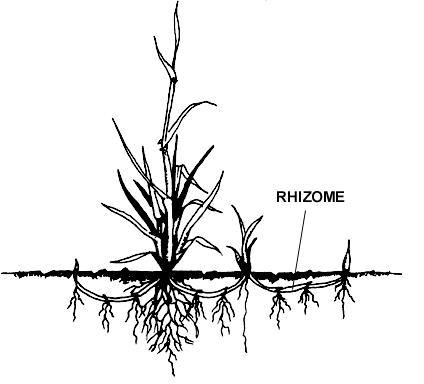 I've been reading a section of Deleuze & Guarttari's essay 'A Thousand Plateaus: Capitalism and Schizophrenia. I was advised by David Cheeseman my MA tutor to look at the theory of the Rhizome as it applies to Jonathan and my work on creating adaptive creative frameworks. I don't want to attach a response to the work yet as I'm still trying to take in the language of the essay which is pretty hard going. Above however I will take out quotes that interest me and I think have a relevance to the work we're creating.
Subscribe to:
Posts (Atom)
